4/Cf4apdqJ0FYSO4yRyb2tIKNu_rpxkY0EwShvogyCArY
All Posts By

admin

The Richard Series Part 1: Seana McKenna

By | Announcements

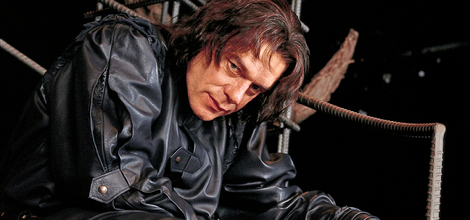
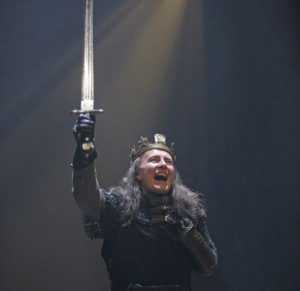
A coveted role from its debut, Richard III has been a delicious vehicle for actors for hundreds of years. Over the next few weeks, our Richard Series will offer the perspective of 3 distinctive Richards who have pondered the same 3 questions about playing the role. We start with Seana McKenna, who has spent 22 seasons at The Stratford Festival and is currently playing Madame Arcati in ‘Blithe Spirit’ & Queen Elizabeth I in ‘Mary Stuart’. In 2011, she played the title role in Richard III at the festival and brings a unique perspective to our Richard Series as one of the few women to have played the part.

1-What was your relationship with the audience while playing Richard and did it change throughout the play?

Richard’s relationship with the audience is paramount. The first words of the play are Richard’s, speaking to the audience. He invites them to be confidantes, co-conspirators, and makes them complicit in his plots. He wants them to laugh with him at all the idiots around him who cannot see through his duplicity, encouraging the audience to feel superior to these gulls. We like him – he makes us laugh, he seems smarter than everyone else on stage, and he is the underdog. Above all, Richard is a sublime actor. He revels in his ability to turn on the tears, to entertain, to be whatever anyone wishes him to be in order to get what he wants. He delights in his versatility, in the fact that he is a consummate impostor. And the only reason for an actor to exist is his or her audience. It is a co-dependent relationship. In the production I was in, director Miles Potter found a moment where I stopped talking to the audience, excluding them from my confidences, no longer trusting even them. That is when Richard is truly alone. His last soliloquy seems more like Richard talking to himself out loud, than a direct address to the audience.

2-How did you develop the physicality of the part and what informed your choice?

Director Miles Potter, designer Peter Hartwell and I were all determined that playing Richard would not seriously injure my body, as it has so many other Richards. You can go many ways with Richard’s alleged and talked-about deformities, but ultimately, we wanted what people said of him to be true, that there would be a reason why the other characters use animal imagery in their descriptions of him, besides describing his inhumane internal self. We wanted to create a strange creature, both female and male, or neither, who was the embodiment of evil, a creature who more than anything else, was closest to the popular character from medieval mystery plays, Vice.

The first practical consideration was which arm to “wither”. Richard has a broadsword fight at the end, and I am right-handed, so we withered the left arm. To accentuate the smallness of my own hand, Peter and cutter Joanna Billings designed a corset/hump that was also built up and padded on the right shoulder, upper chest and arm. This made my right side look square, muscular and male, while binding my breasts and curving my spine with sculpted foam. Lightweight, and leaving the hips and legs utterly free. I curled my hand and rested it on my flattened chest at all times.

After trying out many gaits in my kitchen in the preceding months, I worked with Alexander teacher Kelly McEvenue and movement teacher Wendy Allnutt on my walk. I wanted no lifts in my shoes or anything external to force my walk- I wanted to divest myself of my “deformities” whenever I walked off-stage. We developed a rolling, loping kind of gait, that was irregular in rhythm and that allowed me to move very quickly, cutting figure eights in space. If I had to describe my outward appearance by the end, I would say it was close to a bird of prey, a small vulture…a black crow.

To aid in making me appear more masculine, or perhaps more gender-neutral, we decided I would have a receding hairline, with long stringy hair. Think aging second-rate rock star. I put on a bald pate first, and wig mistress Julie Scott and I applied makeup to the pate and my face, complete with red spots and blotches , almost as though I had had a difficult birth. On top of the pate, I wore the thin slightly oiled wig that Gerry Altenburg created for me. I darkened and thickened my brows. Sometimes I would look in the mirror and think, “Something’s missing”. And I realized the makeup was not complete until I changed my view of the world, and saw the world through Richard’s eyes. The inside had to colour the outside, and Richard’s insides were…bleak.

3-Did anything surprise you about playing the role?

I knew that Richard would be, had to be, fun – if my interpretation was going to translate. As Richard delights in his acting abilities, I had to delight in my own. Richard has a marvellous sense of humour, black though it may be, and for most of the play I think the audience laughs with him. After the innocent princes are murdered, their laughter ceases. I knew I would find pleasure playing him, but I did not think that playing Richard would be as exhilarating as it was, on many levels. First, I was able to combine my years of experience with a leading Shakespearean role, something very rare for a woman over fifty, but customary for a male actor. Most major Shakespearean roles for women are played when you are in your twenties and thirties, occasionally your forties. So this was a gift, to lead a company when I actually had the experience to warrant it. It was liberating to play a man, and a villain, and not apologize for speaking my mind or reacting as forcefully as Richard does. The face could be as unattractive and unpleasing as possible, the outward appearance actually repulsive. ( We were not going for the sexy leading man with a hump idea, but a being who obsessively observes and consequently knows how to manipulate people) .

What also surprised me was my sense of camaraderie with the males in the company, and I remember feeling this at fight call before each show. I felt part of a pack, part of the majority – and to feel it in a Shakespeare play was strange, but comforting. Is this what men feel like all the time in a classical company? Is it a good thing for them? Do they feel supported, or competitive? I don’t know. I do know that as a woman playing a man, I was allowed to straddle both worlds at once, and felt part of both. I could enter either washroom without apprehension. But I didn’t.

The other thing that surprised me was how attached I became to my dagger, hanging at my hip. Hmmm….

Seana McKenna's RIII

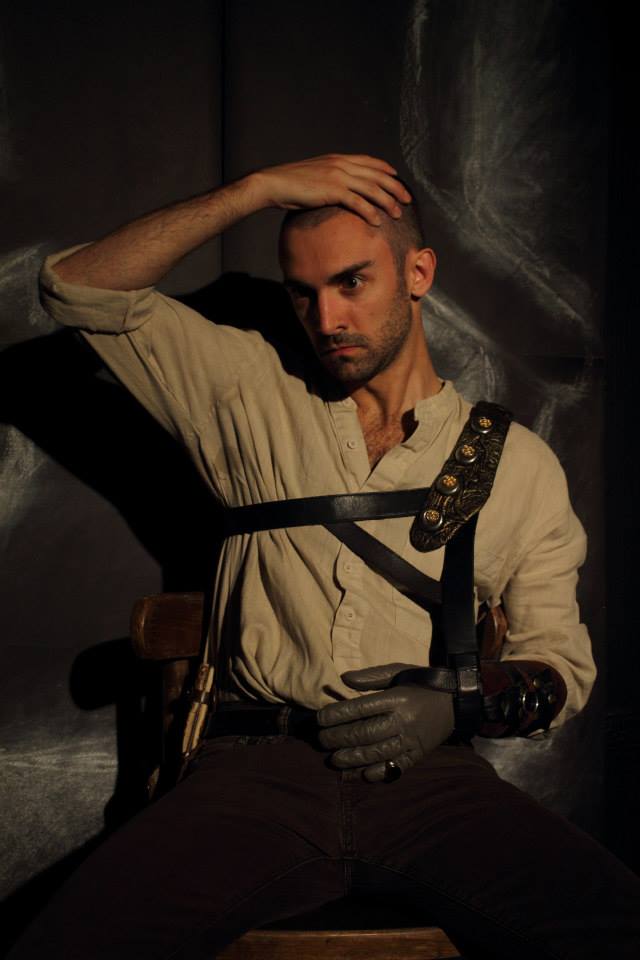
Next in our Richard Series, Tim Welham, takes us on the journey of his one-man Richard III; Crookback.


Four Nominations for “Two Gents”

By | Announcements

We were very excited to find out that our 2012 production of “Two Gents” was nominated for four awards by My Entertainment World (www.myentertainmentworld.ca), in the category of Regional Theatre:

Best Production

Best Ensemble

Best Director: Brendan McMurtry-Howlett

Best Supporting Actor: David Patrick Flemming (seen above as Speed-making a run for it)

Both Brendan and David were interviewed by Kelly Bedard about their nominations and below they answer the question: Do you have a favourite moment in the production?

Brendan: In the very first scene, the audience watches as the servant Speed (played by David) comes running all the way across the field behind our stage carrying a huge armful of suitcases, running late for the train, screaming his master’s name the whole way, and the wipes out just before he reaches the stage in a mess of flying parcels. You would never be able to stage something like that in a theatre and it was the epitome of why I love that outdoor space.

(click here for full interview)

David: Standing in the wings waiting to come on and looking at this little intimate charming stage in the middle of a park. Humbly lit with hundreds of people hanging on to every word. It was a beautiful image.

(click here for full interview)

Congratulations to all the nominees!


Lois talks to Kimia (2012 Young Ruffian)

By | Announcements

(Lois Adamson, our Youth Development Coordinator, speaks to one of the Young Ruffians about her experience last summer with Shakespeare in the Ruff)

We were fortunate to work with an amazing group of committed and passionate young people who took part in our inaugural Young Ruffian Apprenticeship Program last summer. Kimia was one of these young people. We learned so much from her incredible dedication, creative spirit and passion for theatre and it was wonderful to chat with her 7 months later to hear her reflect on her experience.

Kimia, why did you decide to apply to take part in the Young Ruffian Apprenticeship Program last summer?

What really drew me to the program was that I wanted to gain more insight on understanding Shakespeare. High school English classes do the work no justice, especially since many references in modern literature come from Shakespeare’s work itself. I felt like I was missing out on something very crucial just because I didn’t understand it. Kind of like that moment when everyone’s in on an inside joke and you’re not.

Can you describe your experience with us last summer in 5 words?

Shakespeare finally makes sense now .

What moment stands out most strongly in your mind?

The opening night of the show. It’s one thing to be a part of the rehearsal process of the show but it’s totally something different to see all the layers come together to make one huge spectacle. It’s kind of the reason why I love theatre and all aspect of making theatre.

What was the most challenging part of the program?

Looking past the poetry to see what was being said by the characters. We’re so well-trained to tune out the second we see Shakespeare’s descriptive words that it makes it hard to focus on what is being said. It can feel like you’re looking at a huge blob of words with no understanding of what’s going on. It’s hard to see past that and see what’s going on, sometimes I’d have to read a page over and over again until I understood what was being said. But once I understood what was happening, I saw the clever puns and the beauty in the choices of words. It really helped to have a mentor there as well who could share some insight.

Through your participation in the program, what have you learned about the world of professional theatre?

They made performing it look so easy! Everyone worked with each other in perfect harmony, it was such a breath of fresh air to see that. I learned that it takes A LOT of layers to make a production happen, things that wouldn’t even cross your mind like fundraising and advertising. Luckily, though, this program brought in guest artists from different fields that helped us learn more.

And finally, what advice would you give to future Young Ruffians?

Take in as much as you can out of this program, there are so many resources available to your reach. The cast and crew are there to help you so go out and ask them about their job. Ask the cast questions about their characters, it helps you understand more and it helps them to reaffirm their choices and understanding of their characters (double whammy!) oh…  and most importantly take notes, it’s amazing how much you learn in one day.

Thanks Kimia!

We look forward to welcoming more participants like Kimia this year and spending another amazing summer together with our Young Ruffians in Withrow Park. Our applications are available online now and are due at the end of the month (April 30th). Please share this with a young person in your life who loves theatre and might be interested in joining us.

Long live the King!

By | Announcements

(Alex McCooeye writes about reprising his role as Richard III this summer, with Shakespeare in the Ruff, in Toronto’s Withrow Park)

It’s been five years since Diane D’Aquila directed my fellow classmates and me in Richard III at The National Theatre School. Time flies when you’re murdering royalty. And although it was an incredibly fulfilling experience for all involved, Diane and I have never been able to shake the idea of performing the play again, but this time, outdoors.

Ms. D’Aquila, who has previously played both Margaret and Queen Elizabeth at The Stratford Festival, will be playing The Duchess in our production (she’s too old for Ann now (I mean that respectfully)), has the rare ability to change the entire outcome of a scene with a slight shift in stress, or intention, or focus. During our time together at NTS, we spent as many hours uncovering the play as one might spend digging bones out of a parking lot.

Bad joke.

But one day, late in the process, when inspiration was at a low, and our minds were full of iambic pentameter, or prose, or who cared what the difference was, we were kicked out of our rehearsal room (probably because of those loathed French students (mes intentions sont respectful)). And so we were forced to do a run-through of the play in Laurier Park about 3 blocks down from the school.

Then everything broke wide open.

We had already been thinking of it as a young person’s play. A youthful royal, treacherously battling his way through the old guard to get to the top. But young people can run, and a park allows for running. A lot of it. I stood in the middle as a murderer chased my brother across a baseball field, or a messenger ran over a hillside, or my trusted sidekick cursed me from across the street. All of this chaos with one man at the centre of it, canoodling with the audience all the while.

This is the experience that we’ve been chasing since that fateful afternoon five years ago, and with Shakespeare in the Ruff, we’re bringing that to Withrow Park this summer. We’re dying to share it with you, or should I say murdering?

Final bad joke.

(a sneak peak of Alex inhabiting the hunchback King in our second season announcement video below)

[youtube_video] mdwWxcqPQ7U [/youtube_video]

Ruffing It: Coffee & a Scroll

By | Events

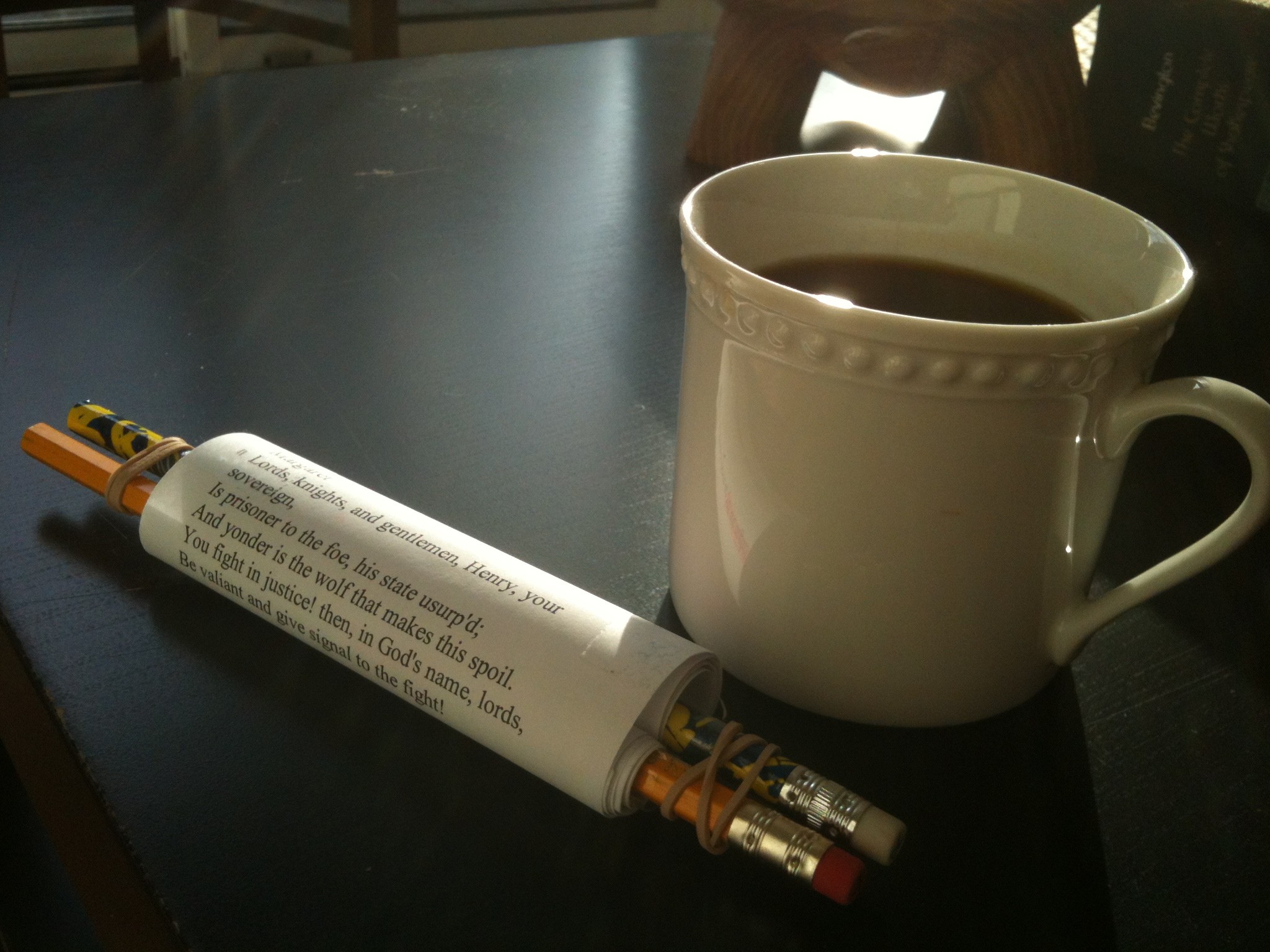
Five days to go until our second annual experiment in Elizabethan original practices. Which practice you may be wondering, and that is of rehearsing, or not rehearing to be more accurate. Very little formal rehearsal was ever recorded in Elizabethan times, the common thought was that it was more of a trial by fire setting where actors learned their ‘roles’ in isolation, with only their lines and their cues to work with, written down for them on a scroll (see our modern, computer aided version above).

For many reasons, only one full copy of the script existed, kept locked up in the theatre vault, and only accessed in a pinch.  “Most notable, every part of every play mounted in the period was written out on a separate scroll. Only one of these remains from the period for the professional theatre-but thousands of these must have existed at one time.” (Cognition in the Globe by Evelyn B. Tribble)   Sunday night, at the Monarch Tavern (12 Clinton St), we will be continuing our exploration of this method of preparation with Ruffing It, this year with battle scenes…should be a riot.

Button Text[lambdaslider id=”lambda_slider_options”]